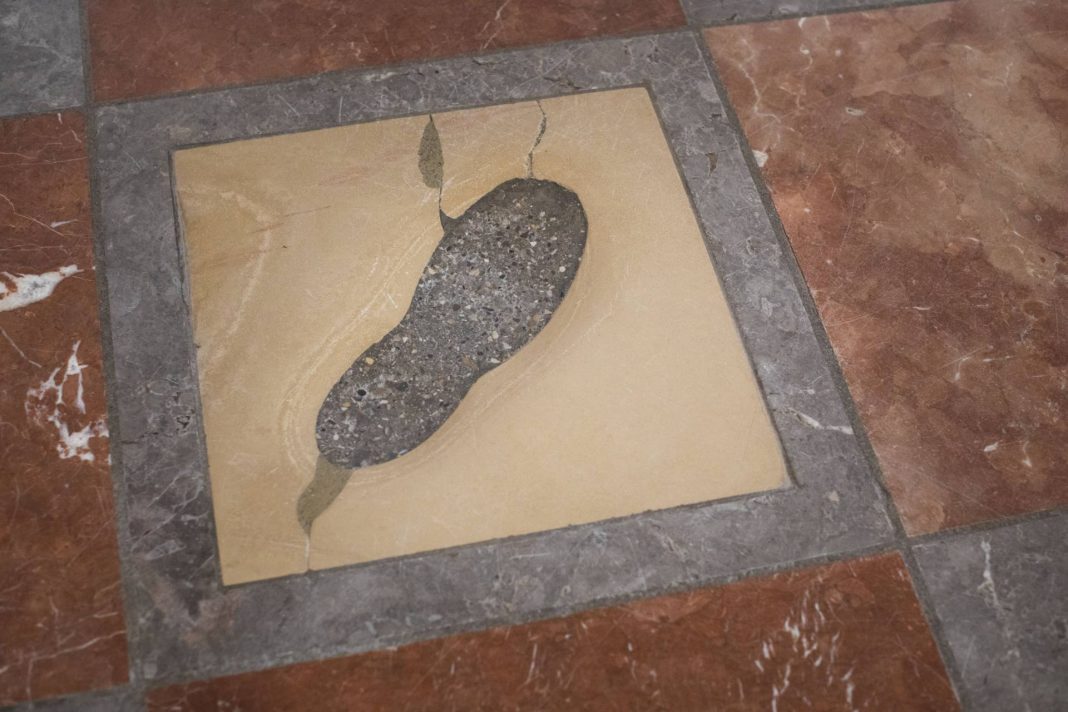
The Devil’s Footprint in Munich . Rising above the red-tiled roofs of Munich’s old town, the twin towers of the Frauenkirche (Cathedral of Our Dear Lady) dominate the Bavarian skyline. Built in the 15th century, this towering late-Gothic brick cathedral serves as the seat of the Archbishop of Munich and Freising. Yet, beneath its sacred arches and magnificent vaulted ceilings lies a far darker, more chilling piece of history—a dark stain embedded in the stone floor known worldwide as the Teufelstritt, or the Devil’s Footprint.
For over five centuries, tourists, historians, and lovers of the paranormal have gathered near the cathedral’s portal to gaze upon the mysterious black imprint, complete with a raised heel spur. While secular historians view the mark as an architectural anomaly or clever medieval marketing, local folklore tells a far more sinister story of a desperate architect, a foolish pact with Satan, and an optical illusion that saved a cathedral’s soul.
The Pact: Building a Cathedral Without Light
The story begins in 1468, during a period of intense construction across Europe. The city of Munich sought to build a massive new congregational church capable of holding up to 20,000 people—a staggering capacity considering the city’s population at the time was under 13,000. Master builder Jörg von Halsbach was commissioned to design and construct the monumental edifice.
However, building such an ambitious cathedral required enormous financial resources, and funds quickly began to run dangerously low. According to Bavarian legend, a mysterious figure appeared to von Halsbach in the dead of night, offering to fund the completion of the cathedral under one strict, bizarre condition: the church must be built completely without windows.
Desperate to complete his masterpiece and avoid ruin, von Halsbach agreed to the pact. He accepted the dark funding, swearing that no windows would be visible inside the sacred space once construction was finalized.
The Optical Illusion: The Devil at the Doorstep – The Devil’s Footprint in Munich
By 1488, construction was complete, and the imposing brick cathedral was ready for its grand unveiling. Before the official consecration, the Devil slipped inside through the heavy wooden doors to inspect the work and claim his prize.
He walked to a specific spot near the entrance foyer, looked toward the main altar, and chuckled in triumph. From that exact vantage point, not a single window could be seen. The massive interior columns, spaced in a double row of high Gothic arcades, lined up with mathematical precision, perfectly blocking the side windows from view. Furthermore, the massive central altar at the far end completely obscured the large stained-glass window at the rear of the choir.
Believing he had successfully forced the construction of a dark, windowless monument to gloom, the Devil stamped his foot down hard on the stone floor in celebratory arrogance. His burning heel scorched a deep, dark footprint into the gray slab—a permanent signature of his presence.
The Deception and the Storm of Wrath – The Devil’s Footprint in Munich
The Devil’s triumph was short-lived. Overjoyed with his apparent victory, he took a single step forward past the initial set of pillars.
As he crossed the threshold, the perspective shifted instantly. The thick columns no longer overlapped, and dozens of tall, magnificent stained-glass windows suddenly revealed themselves, flooding the sacred nave with brilliant, multicolored sunlight.
Realizing he had been outsmarted by human ingenuity and clever architectural geometry, the Devil was consumed by intense rage. He attempted to transform into a roaring wind to destroy the cathedral, but the space had already been blessed and consecrated, rendering his dark powers useless inside. Defeated and humiliated, he fled into the streets of Munich, leaving his scorched footprint behind as a permanent reminder of his failure.
To this day, locals maintain that the cold wind howling around the towers of the Frauenkirche is the lingering breath of the Devil, forever trapped outside, trying in vain to pull down the walls of the cathedral.
Paranormal Phenomena and Local Lore
Beyond the historical narrative, the Teufelstritt has generated a rich tapestry of modern urban legends and ghost stories that continue to intrigue visitors on Munich night tours.
1. The Microclimate Phenomenon
Ghost tour guides and local paranormal enthusiasts frequently report an eerie atmospheric anomaly near the footprint. Visitors often report a sudden drop in ambient temperature near the foyer, describing a cold, clammy draft that seems to cling to the stone floor regardless of the season or heating conditions inside the building.
2. The Melting Snow Legend
According to an old Munich urban myth, winter snow brought in on the boots of churchgoers behaves strangely near the entrance. Locals claim that the snow covering the doorstep directly adjacent to the footprint melts significantly slower than anywhere else in the foyer—as if a perpetual, unnatural chill hovers over the spot where the Devil once stood.
Historical Reality vs. Mythological Charm
While the legend of the Devil’s Footprint brings a touch of gothic mystery to Munich, historians offer a more grounded explanation for the optical illusion:
- Original High Altar Placement: In the 15th century, the cathedral possessed a massive wooden high altar (created by artist Friedrich Pacher) that completely blocked the central choir window from the entry portal.
- Aisle Window Alignment: The original side windows were largely hidden behind the massive interior pillars when standing at the exact center of the entry bay.
- World War II Restorations: During the heavy bombing of Munich in World War II, the Frauenkirche suffered severe structural damage, and its roof collapsed. During the post-war reconstruction in the mid-20th century, the interior layout was altered, and the original altar was replaced.
Today, if you stand on the Devil’s Footprint, you can actually see a window at the far end of the choir due to these modern architectural changes. However, the original row of side pillars still creates a striking visual phenomenon that demonstrates the brilliance of medieval Bavarian craftsmanship.
The Devil’s Footprint in Munich – An Enduring Mystery in Stone
Whether viewed as a clever story crafted by medieval builders to attract pilgrims, a masterclass in Gothic optical geometry, or a genuine supernatural mark, the Devil’s Footprint remains one of Europe’s most captivating church mysteries.
The footprint itself remains embedded in the cathedral floor, quietly welcoming millions of curious travelers each year. It stands as a timeless symbol of Bavarian folklore—a place where faith, architecture, and legend meet, reminding us that even in the brightest halls of light, shadows leave an indelible mark.
More stories like this The Devil’s Footprint in Munich