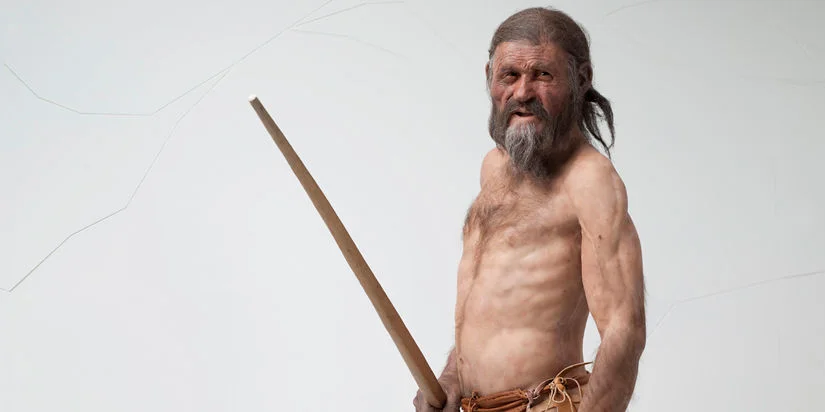
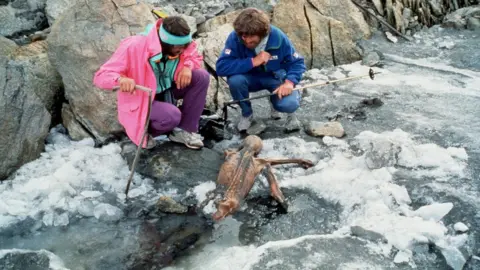
The Alpine Cold Case . High in the Ötztal Alps, near the border between Austria and Italy, two German tourists embarked on what was supposed to be a routine alpine hike in September 1991. Instead, Helmut and Erika Simon stumbled upon something that would forever alter our understanding of human history. Emerging from a melting glacier at an altitude of over 3,000 meters was the brown, dried upper torso of a human body.
At first, local authorities assumed the remains belonged to a modern hiker—perhaps a mountaineer who had lost their way a few decades prior. However, when archaeologists carefully extracted the corpse alongside a crude copper axe, a flint dagger, and a quiver of arrows, it quickly became clear that this was no recent accident.
The individual, who was soon affectionately named Ötzi the Iceman, turned out to be approximately 5,300 years old. Preserved naturally by the ice, extreme cold, and dry mountain winds, Ötzi became the oldest natural human mummy ever found in Europe. But beneath his leathery skin lay a dark, ancient mystery: Ötzi did not die peacefully of old age, nor did he simply freeze in a sudden storm. He was murdered.
A Snapshot of the Copper Age
Ötzi lived around 3300 BCE, during the Chalcolithic or Copper Age—a transitional period in human history when stone tools were gradually being replaced by metalwork. Through meticulous radiological, genetic, and forensic investigations, scientists have managed to reconstruct the Iceman’s life with uncanny detail.
At the time of his death, Ötzi was roughly 45 years old, stood around 160 centimeters (5 feet 3 inches) tall, and weighed approximately 50 kilograms. By modern standards, he was middle-aged, but in the harsh prehistoric world, he was an elder. His body bore the marks of a demanding life: his joints showed signs of severe wear and tear, his lungs were blackened from sitting near open hearth fires, and he suffered from intestinal parasites.
Despite these ailments, Ötzi was exceptionally well-equipped for his environment. He wore complex garments crafted from sheep, goat, and bear leather, stitched together with animal sinew. On his feet were waterproof shoes lined with moss and woven grass for insulation. His most prized possession was a beautifully forged copper axe—an item of immense value and status during his era, suggesting he held a position of importance within his community.
Over 60 Tattoos: Ancient Art or Early Medicine?
One of the most fascinating discoveries on Ötzi’s body was his extensive skin ornamentation. Examination revealed a total of 61 tattoos, arranged in simple lines, hatches, and cross shapes across his body.
Unlike modern tattoos, which are often decorative or symbolic, Ötzi’s markings were functional. They were created by making fine incisions in the skin and rubbing soot or charcoal into the cuts. Interestingly, nearly all of these tattoos are located directly over joints and body parts that showed radiological evidence of degeneration, such as his lower spine, knees, and ankles.
Scientists strongly suspect these markings represent an early form of acupuncture or pain-relief therapy. If true, this indicates that advanced therapeutic practices were being utilized in Western Europe thousands of years before similar techniques were documented in ancient China.
The Breakthrough: Finding the Lethal Blow
For a decade after his discovery, the prevailing theory was that Ötzi had succumbed to extreme weather conditions after getting lost in the mountains. It was not until 2001, when researchers conducted a high-resolution X-ray scan of his torso, that a startling revelation changed everything.
Tucked deep within his left shoulder, mere centimeters from his lung, was a flint arrowhead.
The arrow had struck Ötzi from behind. Further CT scans revealed that the projectile had pierced a major artery, causing rapid and severe internal bleeding. Forensic experts concluded that the injury would have been fatal within minutes. Ötzi had been ambushed.
Reconstructing the Final Hours
With the murder weapon identified, multidisciplinary teams of botanists, pathologists, and archaeologists set out to map the Iceman’s final 48 hours. By analyzing micro-samples from his digestive tract, scientists uncovered a vivid timeline of his last moves:
- The Downhill Descent: Microscopic analysis of pollen found in his stomach proved that Ötzi had traveled across different vegetation zones shortly before his death. He started at a lower elevation near a coniferous forest before climbing back up into the high mountains.
- A Violent Encounter: Traces of blood found on Ötzi’s dagger and clothing belonged to multiple distinct individuals. A deep cut on his right hand—healed only slightly—showed he had engaged in hand-to-hand combat a day or two prior, likely holding off an attacker in a defensive struggle.
- The Final Meal: Roughly two hours before his death, Ötzi sat down to eat a heavy, nutritious meal. His stomach contained the fatty meat of an ibex (wild mountain goat), red deer meat, ancient einkorn wheat grains, and toxic bracken fern (possibly consumed intentionally as medicine for his stomach parasites).
This last detail is crucial. A man fleeing in terror or actively running for his life does not stop to consume a large, multi-course feast. Ötzi believed he was safe in his high mountain refuge, unaware that his killers were stalking him through the pass.
The Ultimate Prehistoric Mystery: Why?
While modern forensics solved how Ötzi died, the exact motive remains open to debate. Was it a dispute over territory? A personal vendetta stemming from the violent fight he had engaged in days earlier? Or was it an assassination driven by political rivalry within his tribe?

Curiously, Ötzi’s priceless copper axe was left sitting right beside his body. If theft had been the primary motive, the killer would have undoubtedly taken this incredibly valuable tool. Leaving the axe behind suggests the attack was personal, or perhaps the killer feared retribution—or even spiritual curses—if they took the victim’s belongings.
The Alpine Cold Case – A Lasting Legacy for Modern Science
Ötzi the Iceman is far more than a gruesome artifact; he is a bridge connecting us directly to our prehistoric past. Today, his remains are kept in a specially designed climate-controlled chamber at the South Tyrol Museum of Archaeology in Bolzano, Italy, where he continues to yield new secrets.
In recent years, full genome sequencing of his DNA revealed new details about his physical appearance—showing he likely had darker skin and a higher degree of male pattern baldness than originally depicted in early reconstructions.
The investigation into Ötzi’s life and death stands as a testament to human curiosity and technological progress. Through the intersection of botany, genetics, radiology, and crime scene forensics, scientists successfully cracked a 5,000-year-old cold case—giving a voice back to a lone traveler whose story was buried beneath the ice for millennia.