The Highest Budget Movie Sequences of All Time: Hollywood’s Most Expensive Scenes . Modern cinematic storytelling often requires extraordinary financial investments. While entire feature film budgets can reach hundreds of millions of dollars, directors occasionally allocate massive portions of their total production capital toward executing a single, iconic scene. Whether building full-scale functional ocean vessels, crashing real commercial Boeing aircraft, orchestrating massive visual effects battles, or staging multi-vehicle stunt sequences through historic European capitals, these legendary scenes push the boundaries of cinematic scale and budget.
Below is an in-depth breakdown of eight of the highest-budget movie sequences ever produced in cinematic history, ordered by their staggering production costs.
1.The Dark Knight Rises (2012) — Mid-Air Airplane Stunt
Estimated Sequence Cost: $20,000,000
Director: Christopher Nolan
Key Highlight: Practical aerial hijacking executed in real mid-air flight.
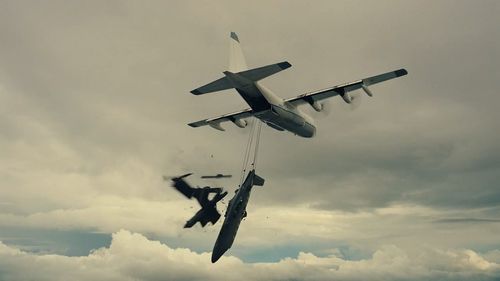
Director Christopher Nolan is celebrated throughout the film industry for his unwavering commitment to practical filmmaking over digital effects. In the opening scene of The Dark Knight Rises, Nolan introduced the villainous Bane (played by Tom Hardy) through a terrifying, high-altitude aerial hijacking sequence.
Rather than relying on green screens or computer-generated imagery (CGI), the production team executed the stunt practically in the skies above Inverness, Scotland. A real Lockheed C-130 Hercules transport aircraft and a smaller turboprop plane were flown in formation. Precision stunt skydivers jumped from the transport plane, attached steel cables to the smaller aircraft, and suspended a stripped fuselage in mid-air before releasing it to crash onto the countryside below.
Between specialized aerial camera rigging, custom flight permits, extensive stunt rehearsals, and operating real aircraft over multiple shooting days, the sequence cost an estimated $20 million for less than six minutes of screen time.
2. Mission: Impossible – Dead Reckoning Part One (2023) — Train Plunging Off a Cliff Finale
Estimated Sequence Cost: $21,000,000
Director: Christopher McQuarrie
Key Highlight: Constructing and destroying an authentic 70-ton locomotive.
The Mission: Impossible franchise led by Tom Cruise has consistently set industry standards for practical stunt work. For the climax of Mission: Impossible – Dead Reckoning Part One (also referred to as Mission: Impossible 7), the production team set out to film a real steam train plunging off a high cliff into a quarry.
Because no existing railway line allowed a real locomotive to be driven off a cliff, the production built a custom, fully functional 70-ton steam train from scratch, alongside a dedicated railway track leading off a quarry precipice in Derbyshire, England.
Executing the sequence required complex mathematical engineering: camera-equipped helicopters, high-speed drones, and ground camera rigs had to capture the destruction in a single, unrepeatable take as the train plummeted into the quarry. Combining custom train fabrication, site engineering, safety protocols, and environmental cleanup, this climactic finale cost approximately $21 million.
3. Tenet (2020) — Full-Size Boeing 747 Airplane Crash
Estimated Sequence Cost: $22,000,000
Director: Christopher Nolan
Key Highlight: Purchasing and crashing a real Boeing 747 airliner into a hanger set.
During pre-production for the sci-fi action thriller Tenet, Christopher Nolan originally planned to use a combination of miniature models and CGI to film a scene where an airplane crashes into an airport hangar to create a distraction. However, after reviewing logistics and costs, Nolan discovered it was actually more cost-effective and visually convincing to purchase a real, decommissioned Boeing 747 aircraft and crash it into a physical building set.
Filmed at the Oslo Airport in Norway, the production purchased a real commercial airliner, rebuilt its interior steering mechanics, and constructed a massive airport terminal hangar set. During filming, the aircraft was taxied under its own momentum across the tarmac, smashing through the hangar wall and detonating real pyrotechnic explosions. The sheer cost of acquiring a commercial plane, building specialized sets, and managing logistics pushed the cost of this short sequence to $22 million.
4. Saving Private Ryan (1998) — Opening Sequence on Omaha Beach
Estimated Sequence Cost: $24,000,000
Director: Steven Spielberg
Key Highlight: Meticulous historical recreation featuring over 1,500 extras.
Steven Spielberg’s visceral portrayal of the D-Day landings on Omaha Beach in Saving Private Ryan remains one of the most celebrated opening sequences in film history. Lasting approximately 27 minutes on screen, the sequence captures the terrifying reality faced by Allied soldiers storming Normandy on June 6, 1944.
To achieve total authenticity, the production avoided studio backlots and filmed on location at Curracloe Strand in Wexford, Ireland. The sequence utilized over 1,500 real extras—including members of the Irish Army Reserve—along with custom-built landing craft, real WWII military vehicles, underwater explosive squibs, and hundreds of gallons of artificial blood.
Filmed sequentially over four weeks without traditional storyboards, the massive logistical scale, historic wardrobe, specialized camera shaking rigs, and stunt coordination pushed the opening sequence cost to $24 million—nearly one-third of the entire film’s total budget.
5. Waterworld (1995) — Assault on the Floating Atoll Set
Estimated Sequence Cost: $47,000,000
Director: Kevin Reynolds
Key Highlight: Constructing a 1,000-ton floating steel island on the open ocean.
Waterworld earned legendary status in Hollywood due to its chaotic production and ballooning budget, which made it the most expensive film ever made at the time of its release. The centerpiece of this post-apocalyptic aquatic epic was the assault on the Floating Atoll, a massive compound where the last survivors of humanity lived.
The production built a real, multi-story floating steel atoll measuring a quarter-mile in circumference off the coast of Kawaihae, Hawaii. The structure contained over 1,000 tons of steel and required floating cranes, underwater construction crews, and constant maintenance.
During filming, a sudden hurricane struck the Hawaiian coastline, sinking the primary atoll set and forcing the crew to rebuild it from scratch. Combined with pyrotechnic stunt jets, watercraft explosions, and open-water filming challenges, this single extended action set-piece cost an astounding $47 million.
6. Spectre (2015) — High-Speed Car Pursuit Through Rome
Estimated Sequence Cost: $50,000,000
Director: Sam Mendes
Key Highlight: Destroying millions of dollars worth of custom luxury supercars.
The James Bond franchise is famous for high-octane luxury car chases, but 2015’s Spectre took vehicle destruction to an unprecedented financial level. The scene depicts a nighttime, high-speed chase through the streets of Rome between James Bond (Daniel Craig) driving an Aston Martin DB10 and villain Hinx (Dave Bautista) driving a Jaguar C-X75.
Because neither model was available as a standard production vehicle, the filmmakers commissioned custom, hand-built concept fleets specifically for the shoot:
Aston Martin DB10: 10 custom models engineered exclusively for the movie.
Jaguar C-X75: 7 specialized stunt vehicles built in partnership with Williams Advanced Engineering.
During the multi-week shoot along the Tiber River and surrounding Vatican streets, multiple custom supercars were completely wrecked during high-speed drifts, jumps, and crashes. Between vehicle destruction, shutting down major historic Roman streets, and night-lighting historic monuments, the sequence cost $50 million.
7. Avengers: Endgame (2019) — The Climactic Final Battle
Estimated Sequence Cost: $60,000,000
Directors: Anthony and Joe Russo
Key Highlight: Uniting dozens of A-list stars in a digital visual-effects spectacle.
As the culmination of a 22-film story arc within the Marvel Cinematic Universe, Avengers: Endgame required a final battle sequence of unmatched narrative and visual scale. The hour-long battle, taking place across the destroyed Avengers compound, pitted dozens of iconic superheroes against Thanos and his alien army.
The financial cost of this sequence was driven by two major factors: an unparalleled ensemble cast and industry-leading visual effects. Bringing together Hollywood’s highest-paid actors—including Robert Downey Jr., Chris Evans, Scarlett Johansson, Chris Hemsworth, and Mark Ruffalo—in a single sequence represented massive talent payroll costs.
Simultaneously, multiple major VFX studios (including Digital Domain, Wētā FX, and Industrial Light & Magic) rendered thousands of complex digital character models, magical effects, terrain destructions, and lighting passes over months of post-production, pushing the final battle sequence cost to $60 million.
8. Titanic (1997) — The Ship Going Down
Estimated Sequence Cost: $141,000,000
Director: James Cameron
Key Highlight: Recreating a near-full-scale replica of the RMS Titanic inside a 17-million-gallon water tank.
Standing atop the list of the most expensive movie sequences ever filmed is the breathtaking final sinking of the ship in James Cameron’s Titanic. To capture the tragic 1912 disaster with historical accuracy, Cameron rejected standard studio water tanks and built Fox Baja Studios in Rosarito, Mexico—a custom-built oceanfront facility featuring a 17-million-gallon horizon water tank.
Inside this massive tank, the production constructed a 775-foot, near-full-scale replica of the RMS Titanic (representing roughly 85% of the original vessel’s actual size). The entire replica was mounted on hydraulic lifts that could tilt the ship up to 90 degrees, allowing it to snap in half and submerge into the water.
The sequence featured hundreds of stunt performers falling off tilted decks, massive hydraulic flooding systems that dumped tens of thousands of gallons of water into custom-built grand staircase sets, and early groundbreaking CGI water physics. When adjusting overall production allocation, the epic final hour depicting the sinking of the ocean liner cost an unparalleled $141 million—a sum larger than the total budget of most Hollywood blockbusters.
The Highest Budget Movie Sequences of All Time – The Evolution of High-Budget Filmmaking
The extraordinary costs associated with these eight sequences reflect Hollywood’s enduring dedication to creating unforgettable cinematic moments. Whether utilizing cutting-edge visual effects or pushing physical stunt engineering to its absolute limits, these scenes demonstrate how directors combine art, money, and ambition to capture the audience’s imagination on the grandest possible scale.