Coca-Cola vs. PepsiCo . The Greatest Corporate Rivalry in Modern History
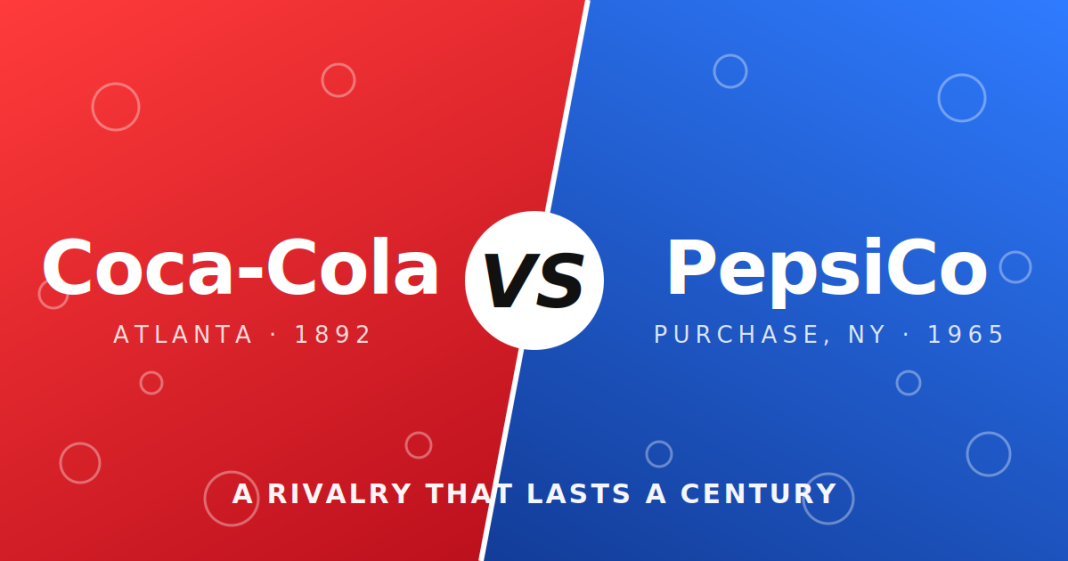
For more than a century, few corporate rivalries have captured the public imagination and defined global consumer markets quite like The Coca-Cola Company and PepsiCo, Inc. What began in the late 19th century as a battle between two carbonated soft drink formulas in American pharmacies has evolved into a multi-billion-dollar global contest spanning supply chains, retail shelf dominance, institutional investment strategies, and international market penetration.
While consumers often view this rivalry through the simple lens of taste preferences—the classic “Cola Wars”—investors, financial analysts, and corporate strategists view it through a radically different prism. Beneath the iconic red and blue logos lie two fundamentally distinct corporate philosophy models:
- The Pure-Play Beverage Titan: Coca-Cola focuses almost entirely on liquid refreshment, leveraging ultra-high profit margins, an asset-light franchising model, and unmatched global brand equity.
- The Diversified Powerhouse: PepsiCo operates a massive dual-engine strategy, combining drinks with a dominant global snacks and convenient foods empire (Frito-Lay, Quaker Oats) that drives massive top-line revenue
Understanding the structural differences, financial metrics, and strategic positioning of these two behemoths offers invaluable insights into brand management, international expansion, and corporate portfolio construction.
Coca-Cola vs. PepsiCo – Corporate Foundations and Leadership
Both organizations trace their origins to late-19th-century America, yet their path to becoming modern global powerhouses diverged significantly in their corporate structures and geographic centers of control.
| Metric / Dimension | The Coca-Cola Company | PepsiCo, Inc. |
| Founded | 1886 (Company incorporated 1892) | 1898 (PepsiCo formed via merger in 1965) |
| Corporate Headquarters | Atlanta, Georgia, USA | Purchase, New York, USA |
| Current Executive Leadership | James Quincey (Chairman & CEO) | Ramon Laguarta (Chairman & CEO) |
| Core Heritage | Pharmacist John Stith Pemberton | Pharmacist Caleb Bradham |
Coca-Cola’s headquarters in Atlanta, Georgia, has served as the political and strategic command center for its pure-play strategy for over a century. Under the leadership of Chairman James Quincey, Coca-Cola has doubled down on streamlining its core beverage portfolio, shedding non-core assets, and focusing on high-margin beverage categories.
Conversely, PepsiCo was formed in its modern iteration in 1965 through the transformative merger of Pepsi-Cola and Frito-Lay. Operating out of Purchase, New York, Chairman and CEO Ramon Laguarta oversees a vastly more complex operational ecosystem that balances liquid beverages with savory snacks, breakfast foods, and sports nutrition.
Coca-Cola vs. PepsiCo – Market Capitalization and Valuation Dynamics
The stark difference in market capitalization—where Coca-Cola commands nearly double the market value of PepsiCo—stems directly from Coca-Cola’s operating margins and valuation multiples. Investors routinely pay a premium for Coca-Cola’s asset-light business model and higher return on invested capital (ROIC).
Institutional Ownership & Major Shareholders
Both companies are bedrock holdings for global institutional asset managers, including Vanguard, BlackRock, and State Street. However, their flagship individual backing differs sharply:
- Coca-Cola’s Anchor Investor: Berkshire Hathaway, led by legendary investor Warren Buffett, holds a massive, iconic stake ($\approx 9.3%$). Buffett has famously held Coca-Cola stock for decades, praising its durable economic “moat,” pricing power, and consistent dividend yield.
- PepsiCo’s Ownership Base: Characterized by widespread institutional control (Vanguard, BlackRock) without a single iconic individual anchor holding comparable to Berkshire’s stake in Coca-Cola.
Coca-Cola vs. PepsiCo – Business Focus: Pure-Play vs. Diversified Ecosystem

The defining strategic divergence between the two giants lies in their operational focus and product portfolio design.
The Coca-Cola Company: Pure-Play Focus
Coca-Cola operates almost exclusively as a liquid beverage company. Its portfolio covers every major liquid refreshment category, including:
- Sparkling Soft Drinks: Coca-Cola, Sprite, Fanta, Diet Coke, Coca-Cola Zero Sugar
- Hydration, Value-Added Water & Sports Drinks: Dasani, Smartwater, Powerade, BodyArmor
- Coffee & Tea: Costa Coffee, Fuze Tea, Gold Peak
- Juice, Value-Added Dairy & Plant-Based Beverages: Minute Maid, Simply, fairlife
By avoiding the food manufacturing and agricultural logistics inherent in snacks, Coca-Cola keeps its supply chain leaner and avoids direct exposure to commodity food volatility.
PepsiCo, Inc.: The Snack & Beverage Synergy
PepsiCo operates a balanced multi-category portfolio where snacks and convenient foods account for more than half of overall net revenue. Its key divisions include:
Frito-Lay North America & International: Lay’s, Doritos, Cheetos, Tostitos, Ruffles, Fritos
PepsiCo Beverages: Pepsi, Mountain Dew, Starry, Gatorade, Rockstar
Convenient Foods: Quaker Oats, Pearl Milling Company
This dual-engine strategy creates cross-merchandising synergies at retail levels (e.g., pairing chips and soda in promotional displays) and provides a hedge when beverage sales face regulatory or consumer headwinds.
Coca-Cola vs. PepsiCo – Financial Performance: Revenue Profile and Profit Margins
A direct side-by-side comparison of top-line revenue versus bottom-line margin expansion illustrates the fundamental trade-off between the two corporate architectures.
| Financial Metric | The Coca-Cola Company | PepsiCo, Inc. |
| Annual Top-Line Revenue | approx $48 – $50 Billion | approx $94 – $97 Billion |
| Gross & Operating Margins | approx 28%-30% Operating Margin | approx 14%-16% Operating Margin |
| Revenue Profile Strategy | Higher margin per dollar of sales | Larger top-line scale & total revenue cash flow |
| Global Reach | 200+ Countries & Territories | 200+ Countries & Territories |
How Coca-Cola Achieves Superior Margins
Coca-Cola achieves its enviable operating margins primarily through its concentrate model. Coca-Cola manufactures concentrated syrups and bases, which it then sells to independent bottling partners worldwide (such as Coca-Cola Europacific Partners or Coca-Cola FEMSA).
These bottling partners bear the capital-heavy burdens of local manufacturing, bottling, fleet delivery logistics, and physical store distribution. Consequently, Coca-Cola collects high-margin concentrate revenue while keeping its capital expenditure (CapEx) commitments relatively low.
How PepsiCo Drives Massive Scale
PepsiCo maintains direct control over a much larger portion of its manufacturing, snack processing, and direct-store-delivery (DSD) distribution networks. While this results in higher capital expenditure, labor expenses, and lower operating margin percentages, it generates vast absolute top-line cash flow (approx $95 billion annually), giving PepsiCo immense purchasing power with agricultural suppliers and national retail chains.
Coca-Cola vs. PepsiCo – Key Competitive Strengths & Flagship Brand Portfolios
Both enterprises possess iconic brand equity, yet their competitive moats are constructed upon different structural pillars.
Coca-Cola: Global Brand Power and Iconic Identity
Flagship Brands: Coca-Cola, Sprite, Fanta, Coca-Cola Zero Sugar, Powerade, Minute Maid.
Core Strength: Unrivaled brand recognition and emotional resonance. The trademark red logo is recognized by over $90%$ of the world’s population.
Global Footprint: Distribution extending across more than 200 countries, supported by deep-rooted local bottling partnerships that make it difficult for new market entrants to replicate its distribution scale.

PepsiCo: Portfolio Diversification and Snacks Monopoly
Flagship Brands: Pepsi, Mountain Dew, Gatorade, Lay’s, Doritos, Cheetos, Lipton, Quaker.
Core Strength: Market dominance in savory snacks. Through Frito-Lay, PepsiCo controls an overwhelming majority of the salty snack market share in North America and key international markets.
Resilience: If soft drink consumption declines due to health trends or soda taxes, PepsiCo’s snack division and sports hydration categories (Gatorade) act as an effective financial buffer.
Coca-Cola vs. PepsiCo – Strategic Outlook and Future Challenges
As consumer health consciousness rises and macroeconomic pressures persist, both Coca-Cola and PepsiCo are evolving their strategies to maintain growth and protect shareholder value.
- Portfolio Healthification and Reformulation
Both companies are actively reformulating products to reduce added sugars, launching zero-sugar drink variations (such as Coke Zero Sugar and Pepsi Zero Sugar), and acquiring health-focused brands in prebiotic sodas, sparkling waters, and functional nutrition. - Inflation and Pricing Power
In periods of global inflation, both giants have demonstrated pricing power. However, Coca-Cola’s pure-play beverage focus grants it slightly more flexibility to adjust pricing without impacting complex agricultural snack supply chains. - Sustainability and Environmental Impact
Plastic waste, packaging sustainability, and water usage present critical ESG (Environmental, Social, and Governance) challenges for both firms. Both organizations have committed heavily to $100%$ recyclable packaging goals, sustainable water replenishment projects, and regenerative agriculture initiatives across their supply chains.