The True Bill Gates Story . The story of Bill Gates dropping out of Harvard University to build Microsoft is one of the most famous legends in modern business and technology. It is frequently cited as the ultimate tale of entrepreneurial risk-taking, held up as proof that visionary thinkers must sometimes abandon formal education to pursue their dreams.
However, the popular version of the story often gets the most critical element wrong. Bill Gates was not a gambler making a reckless leap into the unknown. He did not leave university on a whim or out of a distaste for academics. Instead, Gates recognized a narrow, fleeting window of opportunity in technological history—a window that was closing rapidly—and possessed a unique decade-long preparation that allowed him to move before anyone else realized the revolution had begun.
Here is the real, inside story of how a magazine cover, a bold bluff, and relentless coding created the foundation of personal computing.
The True Bill Gates Story – The Beginning: Preparation Long Before Harvard

To understand why Bill Gates left Harvard in 1975, one must look back to 1968. At just 13 years old, while attending the Lakeside School in Seattle, Gates was introduced to a teletype terminal connected to a mainframe computer. At a time when computing technology was completely foreign to most adults, Gates and his friend Paul Allen became hopelessly obsessed with software architecture and programming languages.
By the time Gates arrived at Harvard University in the fall of 1973, he was not a novice student entering a new field. He had already accumulated thousands of hours of hands-on programming experience, writing software for local businesses, analyzing traffic flow data, and building specialized systems.
While Harvard provided access to brilliant mathematical minds and world-class academic resources, it lacked the specific, urgent focus that consumed Gates’s mind: the belief that individual computing power was about to transform human society.
The Catalyst: A Magazine Cover That Changed Everything
In early 1975, a single magazine issue fundamentally altered the trajectory of computing history. Paul Allen was walking through Harvard Square when he spotted the January 1975 cover of Popular Electronics. The cover featured the Altair 8800—a boxy, primitive kit machine created by Micro Instrumentation and Telemetry Systems (MITS) in Albuquerque, New Mexico. It was heralded as the world’s first commercially viable personal computer.
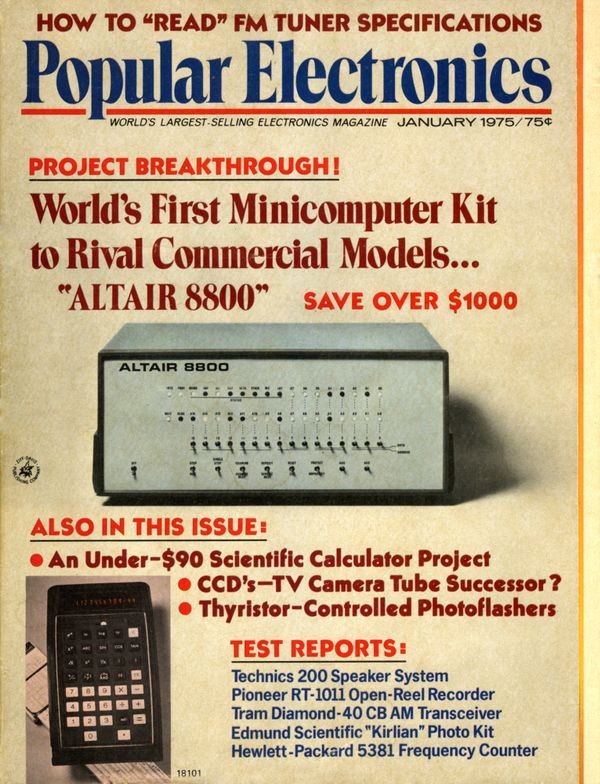
Allen ran to show the magazine to Gates. Looking at the photo of the Altair 8800, both young men instantly grasped the profound shift taking place:
- Hardware was Becoming Accessible: The advent of cheap microprocessors meant that individuals would soon own personal computers.
- Software Would Eclipse Hardware: A computer without software was merely a box of lights and switches. The true value lay in creating an accessible programming language that allowed everyday users to write applications.
- The Window Was Closing: They realized that software developers across the globe would see the same magazine cover and reach the exact same conclusion. They had a matter of months—perhaps weeks—before established companies entered the space.
Gates and Allen understood that if they did not act immediately, the opportunity to define the software foundation for personal computing would disappear forever.
The Decision and The Great Bluff
Determined not to let the window shut, Gates and Allen took a massive gamble. They contacted Ed Roberts, the founder of MITS in Albuquerque, and claimed they had already developed an operational BASIC programming language interpreter specifically tailored for the Altair 8800 processor.
In reality, they had written zero lines of code for the Altair. They didn’t even own an Altair 8800 computer, nor had they ever seen one in person.
Roberts was intrigued and told them that the first team to demonstrate a working BASIC interpreter in his Albuquerque office would land the contract. The clock immediately began ticking. Gates and Allen had created a high-stakes scenario with no safety net and no second chance.
The True Bill Gates Story – The Challenge: Weeks of Relentless Coding
What followed was several weeks of extraordinary, round-the-clock software engineering. Working out of Harvard’s computer lab, Gates and Allen labored tirelessly to build a software system for a machine they physically did not possess.
To accomplish this impossible task, they used a technical workaround:
- Simulating the Processor: Paul Allen wrote a software emulator on Harvard’s PDP-10 computer to mimic the exact behavior and hardware architecture of the Altair’s Intel 8080 microprocessor.
- Writing the Interpreter: Gates worked feverishly on paper and terminal, coding the BASIC interpreter line by line, optimizing memory usage down to the single byte to ensure it could run within the Altair’s tiny 4-kilobyte memory limit.
Driven by pure belief and urgency, they barely slept. In March 1975, Paul Allen boarded a flight to New Mexico carrying paper tape containing the untested code. Neither Gates nor Allen knew if the simulation was accurate or if the software would crash the moment it loaded into a real Altair machine.
When Allen loaded the tape into the Altair 8800 at MITS headquarters, the machine responded perfectly on the very first attempt. It printed “READY” on the teletype output—a monumental success that marked the birth of personal computer software.
His Path: From Harvard Dropout to Global Software Giant
With the MITS contract secured, Gates made the formal decision to take a leave of absence from Harvard to manage their new venture full-time. In April 1975, Gates and Allen officially launched their partnership, naming it “Micro-Soft” (later dropping the hyphen). Gates was just 19 years old.
Although his parents initially hoped he would return to complete his pre-law studies and earn his degree, the temporary break quickly became permanent. The software revolution was moving too fast for him to return to the classroom.
Under Gates’s fierce leadership and strategic vision, Microsoft grew from an Albuquerque office into the world’s dominant software company, placing an operating system on nearly every personal computer desk globally. Decades later, the smiling young man whose mugshot was taken after a minor traffic arrest in New Mexico had become the world’s wealthiest individual and a global technology icon.
In 2007, 32 years after walking away from his studies, Bill Gates finally returned to Harvard University to receive an honorary doctor of laws degree. Opening his commencement address with his trademark dry humor, Gates joked: “I’ll be changing my job next year… and it will be nice to finally have a college degree on my resume.”
The True Bill Gates Story – Key Takeaways from the Bill Gates Story
To understand the core lessons behind the founding of Microsoft, consider this strategic breakdown:
| Lesson Category | Common Myth | Real-World Reality |
| Education | Dropped out impulsively without a plan. | Took a calculated leave of absence after securing a major commercial contract. |
| Preparation | Succeeded purely through raw luck and instinct. | Had accumulated over 7 years of deep programming experience prior to 1975. |
| Market Timing | Waited until technology was fully mature. | Recognized a closing window of opportunity and acted before competitors. |
| Risk Management | Gambled everything blindly. | Executed a high-stakes move backed by immense technical competence and effort. |
Bill Gates did not drop out of Harvard into nothingness, nor did he encourage aspiring entrepreneurs to abandon education without cause. He stepped into an extraordinary opportunity that he had spent over six years preparing for, moving swiftly before the window of opportunity closed.
His journey proves that when deep preparation meets rare historical timing, legendary achievements become possible.