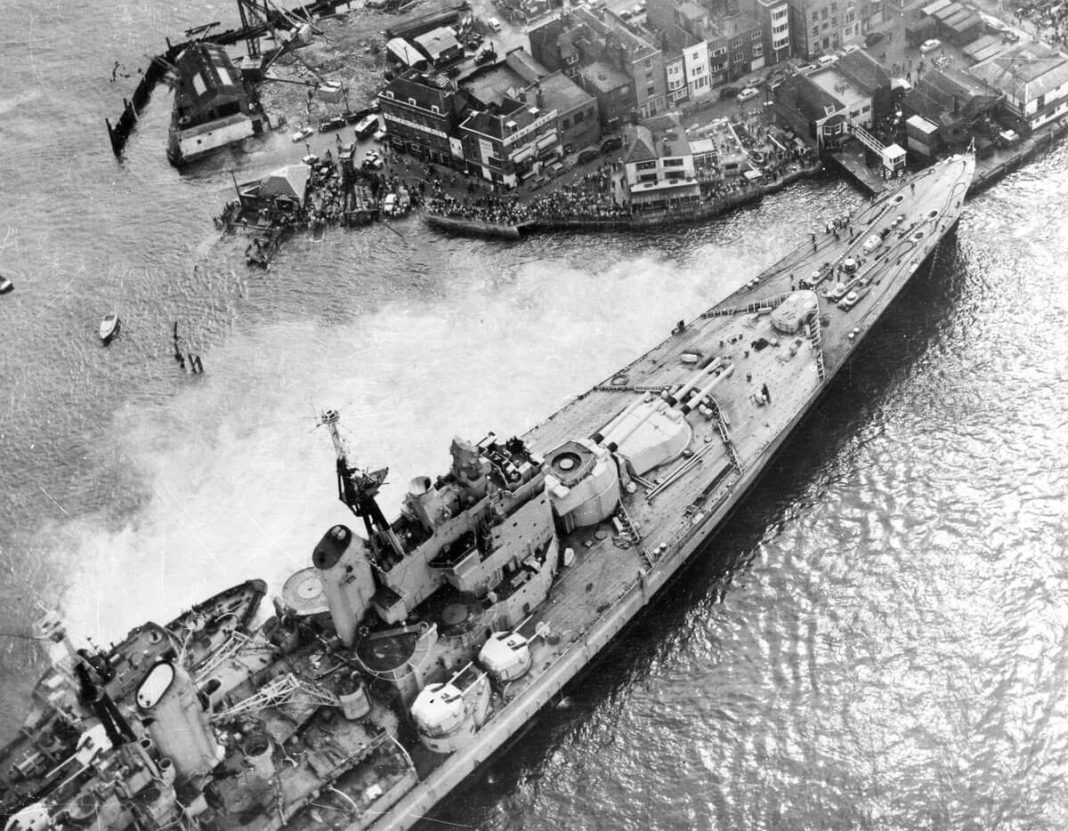
The Top 5 Deadliest Battleships of World War II. During the height of World War II, naval warfare was dominated by massive floating fortresses of steel and fire. Known as battleships, these leviathans represented the pinnacle of industrial engineering, military prestige, and lethal firepower. Armed with giant naval artillery capable of hurling heavy armor-piercing shells over the horizon, they served as the flagships of mighty global navies.
Though aircraft carriers ultimately reshaped naval doctrine by the end of the conflict, the era of the battleship left an indelible mark on military history. Here is a comprehensive look at the top five deadliest and most formidable battleships that ruled the waves during World War II—their specs, their operational histories, and their ultimate fates.
1. Yamato (Japan) – The Mammoth of the Pacific

- Main Guns: 9×460 mm (18.1 inches)
- Displacement: 71,659 tons (Full Load)
- Fate: Sunk in April 1945
Commissioned in December 1941, the Yamato was the largest, heaviest, and most powerful battleship ever constructed. Built in absolute secrecy by the Imperial Japanese Navy, she was designed to counter the superior numerical strength of the United States Navy by single-handedly outgunning any opponent she encountered.
Yamato’s primary armament consisted of nine massive 460 mm guns housed in three triple turrets. These behemoths were capable of firing 1,460-kilogram (3,200 lb) shells over a distance of more than 42 kilometers (26 miles). Her side armor was equally legendary, measuring up to 410 mm thick to withstand heavy fire.
Despite her terrifying capabilities, Yamato’s operational career was largely constrained by fuel shortages and changing naval strategy. She served as the flagship of the Combined Fleet, including during the Battle of Midway. Her final moment arrived in April 1945 during Operation Ten-Go, a desperate suicide mission to attack Allied forces at Okinawa. Swarmed by hundreds of American carrier-based aircraft, Yamato endured dozens of torpedo and bomb hits before suffering a catastrophic magazine explosion and sinking into the East China Sea.
2. Bismarck (Germany) – The Terror of the Atlantic
- Main Guns: 8×380 mm (15 inches)
- Displacement: 50,900 tons (Full Load)
- Fate: Sunk in May 1941
No ship struck more terror into the hearts of the British Admiralty than Nazi Germany’s flagship, the Bismarck. Fast, heavily armored, and technologically advanced, Bismarck was engineered to break out into the Atlantic Ocean and annihilate Allied supply convoys that kept Great Britain in the war.
In May 1941, Bismarck embarked on her first and only operational sortie, Operation Rheinübung. On May 24, during the iconic Battle of the Denmark Strait, Bismarck engaged the Royal Navy. In a dramatic duel lasting only a few minutes, a salvo from Bismarck struck the British battlecruiser HMS Hood, detonating her aft ammunition magazine and sinking the legendary flagship in moments.
The destruction of the Hood sparked a furious hunt by the Royal Navy under the order to “Sink the Bismarck!” Days later, a lucky torpedo strike from a vintage Fairey Swordfish biplane jammed Bismarck’s rudder, leaving her circling helplessly in the stormy North Atlantic. Surrounded by overwhelming British naval forces, Bismarck fought bravely to the end before being pounded into a ruin and ultimately sinking on May 27, 1941.
3. USS Iowa (USA) – The Fast and Modern All-Rounder

- Main Guns: 9×406 mm (16 inches)
- Displacement: 57,540 tons (Full Load)
- Fate: Decommissioned; Served until 1990 (Now a Museum Ship)
Lead ship of her class, the USS Iowa (BB-61) was designed with a perfect balance of firepower, heavy armor, and unprecedented speed. Unlike her heavily armored Japanese counterparts, the Iowa-class battleships were built as “fast battleships” capable of reaching speeds of over 32 knots (59 km/h), allowing them to escort fast carrier task groups across the Pacific theater.
Armed with nine 406 mm Mark 7 main guns, the USS Iowa could rain devastating firepower onto surface targets or shore fortifications. During World War II, she carried President Franklin D. Roosevelt across the Atlantic for key Allied conferences, bombarded Japanese island strongholds during the Pacific campaign, and provided vital air defense cover for American aircraft carriers.
Unlike many of her wartime contemporaries, Iowa’s career did not end in 1945. She was modernized and reactivated multiple times, seeing active service during the Korean War and throughout the Cold War era. She was finally decommissioned in 1990 and today serves as an iconic museum ship in Los Angeles, California.
4. HMS King George V (United Kingdom) – The Royal Navy’s Iron Backbone

- Main Guns: 10×356 mm (14 inches)
- Displacement: 42,100 tons (Full Load)
- Fate: Scrapped in 1957
The lead vessel of her class, HMS King George V was designed under strict treaty limits, resulting in a unique armament configuration featuring ten 356 mm guns distributed across two quad turrets and one dual turret. While carrying lighter main caliber artillery than American or German rivals, her armor protection and radar-guided fire-control systems were world-class.
King George V formed the backbone of the British Home Fleet during the darkest days of the conflict. Her most famous engagement took place in May 1941, when she served as the flagship during the final battle against the German battleship Bismarck. Alongside HMS Rodney, King George V repeatedly battered the German titan at close range until Bismarck was completely neutralized.
Throughout the rest of the war, King George V covered Atlantic convoys, participated in Allied landings in the Mediterranean, and eventually transferred to the Pacific Fleet to bombard the Japanese mainland. After a distinguished service record, she was decommissioned after the war and scrapped in 1957.
5. Richelieu (France) – The Pride of the French Navy

- Main Guns: 8×380 mm (15 inches)
- Displacement: 35,000 tons (Standard) / 44,698 tons (Full Load)
- Fate: Scrapped in 1968
The Richelieu was a masterpiece of French naval architecture. Designed specifically to counter the growing threat of the Italian Navy in the Mediterranean, Richelieu possessed a distinctive design feature: all eight of her 380 mm main guns were mounted in two quadruple turrets on the forward deck, allowing her to bring maximum firepower to bear while presenting a smaller target profile.
Following the fall of France in 1940, Richelieu’s career took a tumultuous path. Stationed in Dakar, West Africa, she briefly fired on Allied forces to prevent her capture. However, in 1943, she re-joined the Allied cause and was sent to the United States for an extensive modernization refit in New York.
Upgraded with advanced American radar and heavy anti-aircraft weaponry, Richelieu joined the British Home Fleet and later operated in the Indian Ocean, participating in operations against Japanese positions in Southeast Asia. Beautifully built, swift, and resilient, Richelieu served into the post-war era before being scrapped in 1968.
The Top 5 Deadliest Battleships of World War II – The Sunset of the Battleship Era
The naval clashes of World War II demonstrated both the overwhelming force of the battleship and its ultimate vulnerability to naval aviation. While ships like Yamato and Bismarck represented the absolute peak of naval artillery engineering, air-launched torpedoes and dive bombers ultimately proved that air supremacy would define the future of ocean warfare.
Nevertheless, these five steel titans remain legendary symbols of military history—monuments to engineering ingenuity, courage, and the sheer scale of mid-20th-century warfare.